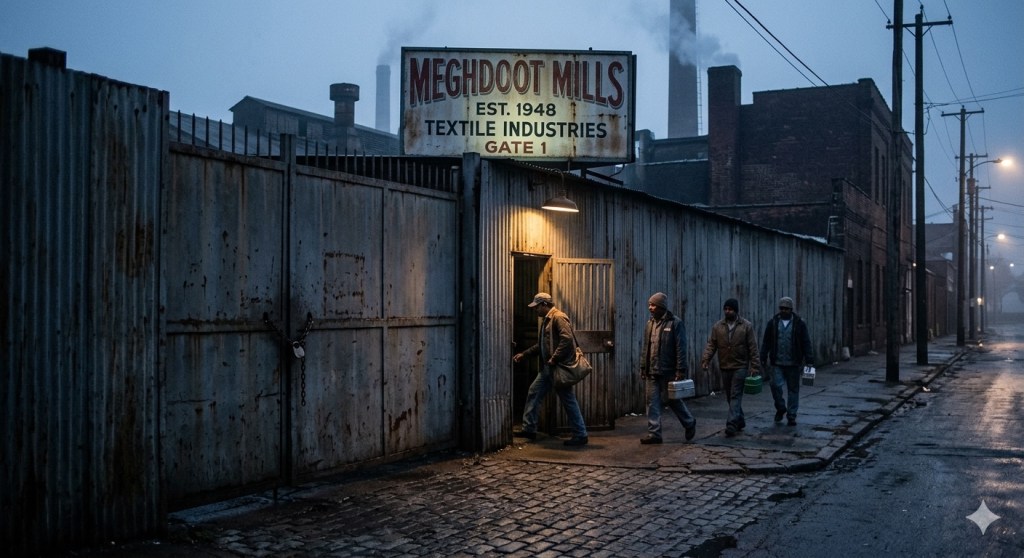
Before the city is awake the gate of Meghdoot Mills is already open. It is a small gate, let’s call it man-sized, over the contemporary person-sized, because it is a norm for men to walk in through it. It cuts in a sheet-metal wall that runs the length of two cricket pitches, and it opens only inward, only at the hours the shift demands. The adjacent large gate, the one wide enough for the lorries, stays shut and chained except when a consignment leaves. You cannot walk into Meghdoot. Nobody walks in who has not been called. At six in the morning the called ones come, off the buses, and the small gate takes them one at a time, the way a turnstile takes a coin.
Across the road from the gate, where the tar gives way to dust, Shanti has had her stall open for an hour already. It is the best spot at the crossing, and she did not get it by being gentle. In fact, she did not even get it out of choice. A freak accident, a disruption, and the stall gave her a second chance at life. The water for tea is boiling, the oil is hot, the paper cups are stacked in their tower. She has wiped the bench twice. From here she can see the gate, and the bus stand, and the lane that goes back into Naya Nagar where most of these men sleep four to a room, and she can see who comes and who does not, its own kind of account keeping.
Bhilwara has over four hundred mills like Meghdoot. Between them they spin and weave and dye some twenty-five thousand crore rupees of polyester a year, which makes cloth the second thing this district does after farming, and the first thing it does that the world has heard of. Two and a half lakh people stand at these machines. Three out of every five of them came from somewhere else — from Uttar Pradesh mostly, from Kanpur and Gorakhpur, seven hundred kilometres east along NH27, the long gray highway that runs the breadth of the country and that, the men will tell you, runs only one way. It does not, of course. It runs both ways. A bus leaves Bhilwara for Kanpur every evening. But to the men at Shanti’s bench the eastbound road is a thing you take for a wedding or a death and in good years for a festival as well, and then come back from. And the idea that you might take it and stay, that you might go home and be poor there, has been paved over so many times by so many feet, that none of them can see the turning anymore.
Shanti can. Shanti manages to see most things.
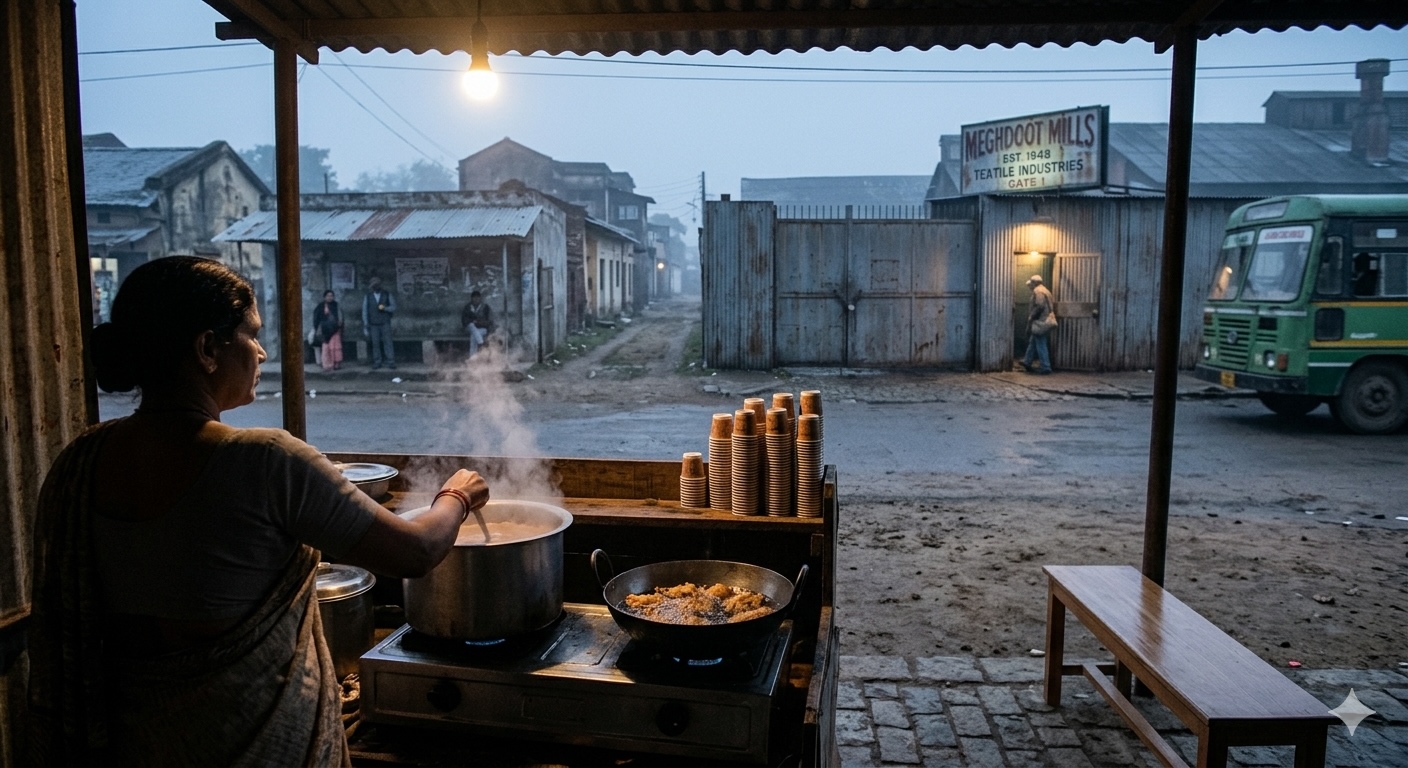
Ramkishan is the first to arrive, and he wants his tea strong because he has not slept. He is thirty, a mill machine operator, five years now on a proper contract with Meghdoot. Providend Fund deducted, Employee Safety Insurance card in pocket always, the gratuity that is supposed to come at the end of the fifth year. He says the word gratuity the way other men say the name of a god. He has done a double shift yesterday, sixteen hours, and he is going to do another tonight, and when Shanti tells him he looks like a corpse, he laughs.
“This is the time to work. When else? A man’s body is for working. The one who does sixteen hours is paid for sixteen. The one who sleeps is paid for sleeping. This is how it should be.”
Albeit, this is not how it is. His July payslip showed fourteen thousand rupees, PF taken out, and the eight extra hours of every double are not on it anywhere, because overtime at Meghdoot is paid in cash by the supervisor at a rate the supervisor decides, and lately the supervisor has been saying, “later, later, when the orders come back.” This does not shatter Ramkishan’s faith on the returns that hard work eventually returns. He has a wife and a toddler back in the room in Naya Nagar, and a plan to buy a plot in his village next to his brothers’, and a figure in his head. And the figure does not survive him if he is faithless. So he drinks the strong tea and goes through the small gate, and the gate takes him in.
His wife is Roshni. She does not come to the stall; he has told her the gate is no place for a woman. “The women who work the floor,” he has said to her, “are the ones whose men cannot earn enough.” Roshni has heard this enough times to have stopped arguing. She keeps the room, she keeps their ten month old, and when her husband sleeps she sits by the window and does the household arithmetic. She is better at it than he is. She has noticed, this past month, that the cash in the supervisor’s envelope has been getting thinner while the hours have been dragging longer.
The orders have not come back because of a thing that happened on the other side of the world, which the men at the gate understand the way one understands weather. A government far away has put a tariff on various Indian products, including cloth. A percentage. Set and then unset and then set again at a different figure, so that for three months now the buyers who used to take Meghdoot’s polyester by the container have been waiting to see what the cloth will cost them before it even reaches a port. A container packed in March is still in the yard. The big gate has not opened for a lorry in days now.
None of this is said at Shanti’s stall in these words. What is said is,
“kaam kam hai” (there is less work)
What is said is that Meghdoot has stopped taking new helpers. What is whispered, over the second tea, is that a list has been made.
*****
The man who has seen the list is Mahaveer, and he comes to the stall after the shift has gone in, when he can sit. Mahaveer is a thekedaar, labour contractor. He is not on any organisation chart at Meghdoot. The chart goes owners, managers, then shift in-charge, then supervisor, the machine operators, and stops. But nothing on the floor moves without him, because it is Mahaveer who brings the men. Forty of them are his, all from two villages he could walk between as a boy. He knows their fathers. He knows what they owe. When Meghdoot needs thirty extra pair of hands by Monday, Mahaveer makes a call, and for this the company is grateful in the way companies are grateful. It let’s him keep ten of every hundred rupees the men earn. When the ninety reaches the men, there are no raised eyebrows.
“I started where they are,” Mahaveer likes to say. He stood at a machine for eleven years. Then he stopped being a man who was brought and became a man who brings. And with the difference he bought a plot in Naya Nagar for seven lakh and built three floors on it and now collects rent from the same men he collects commission from. “If you want to know the truth about a worker,” he tells the researchers from the city who come around with their clipboards and questions, “do not ask his wife, do not ask his neighbour. They will tell you nothing. Ask his landlord. Ask his thekedaar.” He says it as advice.
This morning Mahaveer is not in the best of his moods. He has the list. The list is the company’s answer to the tariff. It is the names of the men who are coming up on five years, to whom the gratuity is about to be owed, and the company has decided that this slow season is the convenient season to let them go, the way it does every few years, so that the fifth year arrives for nobody. Twenty-odd names. Mahaveer’s job is to manage the going, so that twenty men leaving does not become twenty thousand men shouting at a gate.
Devnarayan is on the list. Mahaveer has known this since yesterday and has not yet found the way to say it.
*****
Devnarayan takes his tea black and counts the coins out of a knotted handkerchief. He earns about twelve thousand a month and there are four mouths under it: a wife, a boy who has just started school, and a daughter of five months who arrived with a hospital bill. Three thousand for the room, four thousand for the grain, fifteen hundred for the light and water, the phones, and after the things that cannot be argued with there are about three and a half thousand rupees left to be the whole of his freedom.
Out of that residue, he pays fifteen hundred every month, to the Life Insurance Corporation. It is a policy in his children’s names. It is the single most extravagant and the single most disciplined thing in his life, and he does it because it is the one formal, government-stamped, indestructible thing he has ever been able to own, and because a man who pays an LIC premium is a man with a future, even if the present looks bleak. He is, the clipboard people would say, doing everything right. He is also one shock from the ground. His shock, when it comes, he knows will be the list.
The man who is cheerful at the stall is Sonu, and the others half-envy and half-pity him. Sonu is twenty-seven, a forklift operator at the steel plant down the road, not Meghdoot. He likes to point this out, that he is steel and not cloth, as though the tariff were a thing that could be dodged by category. The mill was his day job since a year now and as a way of compensation, he found his life on Facebook! He has a friend in Italy and a sister in Telangana and a phone that is never out of his hand, and two years ago he borrowed two lakh rupees to take a job in Albania that a man in a video had promised him, and the job dissolved the way the videos always dissolve, and the two lakh did not. He is still paying it back, seven and a half thousand a month, and he pays it, because Sonu does not default; Sonu simply finds the next two lakh.
This morning he is chirpier because of a new video. There is work in Romania, he tells Shanti; packing, good money, euros. A man is taking applications. Shanti, who has heard of Albania, says nothing and pours his tea. “You smirk,” Sonu says, though she has not. “But the ones who do not take the chance, where are they? Still here at this gate.” He gestures at the gate as if it were the proof of his argument.
*****
The small gate opens for the morning shift to come out and the next to go in, and with the men who come out comes the field officer from Udaan.
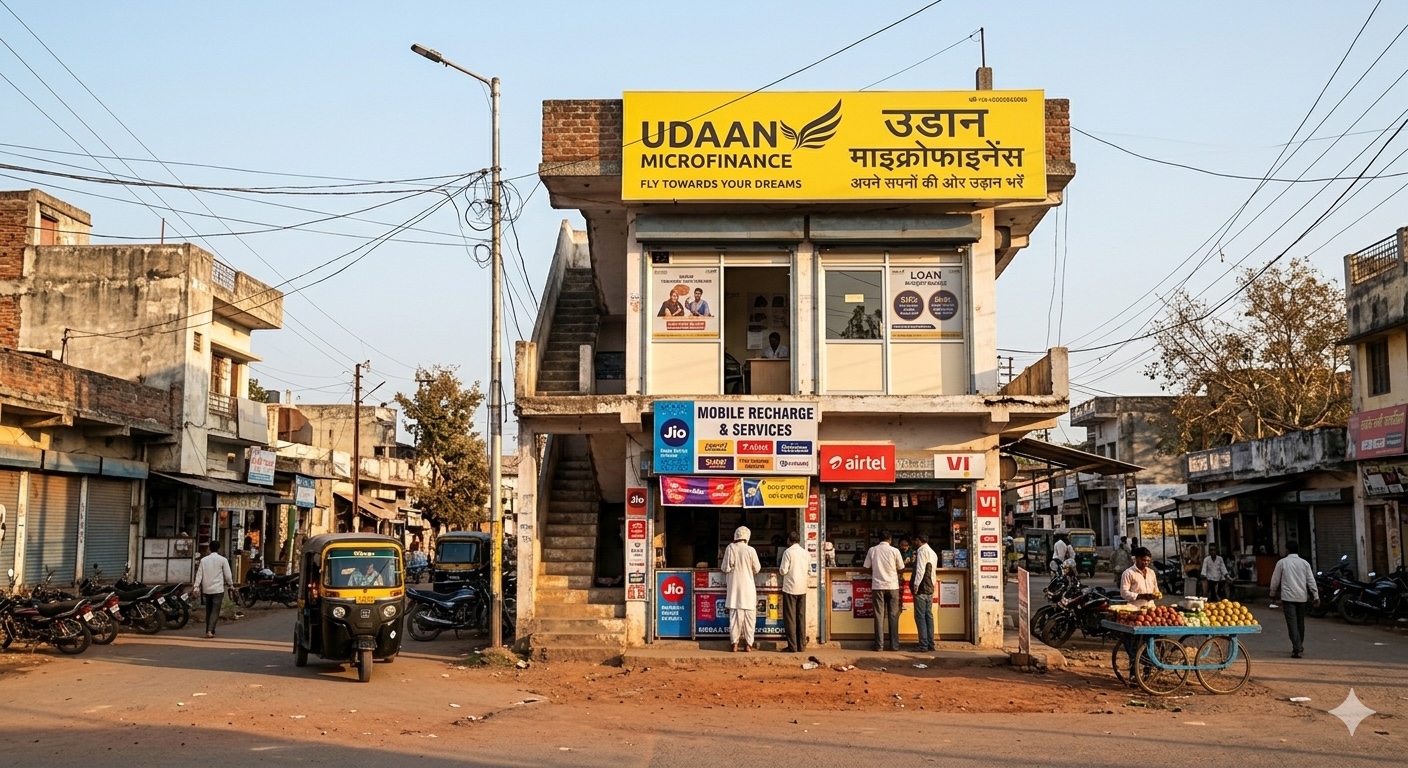
Udaan Microfinance has a yellow signboard and a slogan about flight and a small office above a mobile recharge shop, and it lends forty thousand rupees at a time to people the banks will not look at, because the banks want land or a weighty salary slip or a group of women who will stand surety for each other, and these men have only their willingness. Udaan takes the willingness. Four thousand rupees a month for a year, and the arithmetic of it, when you do is not gentle. Ramkishan has a loan from them and is proud he has never missed; he wants to finish early. “Why keep credit hanging,” he says. Devnarayan has one too. He took it when the baby came, rather than break the LIC. The field officer knows them all by their EMI dates and he comes to the gate on collection days because the gate is where the cash is, fresh from the ‘overtime’ envelope, before it can become anything else.
He is not a cruel man, the officer. He is twenty-four and on a target. Earning about twenty-five thousand a month himself. He greets people by name. He is, in the whole arrangement, the least guilty person, and this is precisely why the story does not turn on him. He is a clog of a machine. The machine is patient and it is legal and it takes its four thousand and it will take its four thousand in a few days from a widow with the same soft apologetic voice it uses on everyone, and that is the worst that can be said of it.
The news comes at noon.
It comes the way news comes from a gate, leaking from the crevices. A man who tells the bus conductor who tells the boy who sweeps for Shanti, so that by the time it reaches the bench it has the shape of a thing everyone already half-knew. Ramkishan has collapsed on the floor. The dye section, the second double in a row, the chemical, the smell, the heat. He went down between the machines and the machines did not stop because the machines do not stop. And by the time they carried him to the small gate, the one that opens inward, he was gone.
There is a particular silence that comes over the stall when this happens, and it is not the silence of shock. Every man at that bench has done the double. For a moment the not-knowing is stripped away and they all see the machine plainly, the way you see a room in a lightning flash, and then, and this is the thing, this is the whole of it, the light goes off again, because a man cannot stand at that gate tomorrow morning if he keeps seeing it. So they push back.
“He should not have done two doubles in a row. His body was weak. He did not eat properly. He was unlucky.”
By the time the tea is cold they have rebuilt the dark, brick by brick.
Mahaveer does the things a thekedaar does. He arranges the body. He calls the village – of course he has the number; he knew Ramkishan’s father. He speaks to the company, and the company is sorry, and the company points out that the man had clocked out, between shifts, that the matter is delicate, that there will be something from ESI for the family, with the right set of papers produced. Half a claim, the way it paid half to the woman whose hand failed on the spinning floor. The way it always pays half, so that the worker is covered the way a short blanket covers a tall man.
*****
And then Shanti crosses the road.
She does not cross the road for many things. But she crosses it now, to the room in Naya Nagar where Roshni is sitting with the boy, and she sits with her, and this is not performative. Shanti’s grief is real, she has known this woman’s husband for a month short of five years, she has fed him ten thousand mornings. She holds Roshni’s hand. She says the true things, that he was a good man, that he worked too hard, that the gate eats the best ones. And then, because she is who the years have made her, she says the other things too, and she says them so gently that they sound like the same kind of thing.
She reminds Roshni what happened when she was a helper inside the spinning floor of Meghdoot. How her hand just would not raise one day and the months that followed were agonising. And the pain in her hands was the least of it. There will be costs, she says. The body to be sent home, seven hundred kilometres, that is not cheap. The rites; the family will expect it be done properly. Shanti can arrange the money. Today, now, no papers, not like those Udaan people with their forms. She has known Roshni’s husband for five years. Naturally, this is not a charity, but there is no rush. Roshni can take her time to return it. It will also be a notch cheaper than Udaan’s rates.
She let’s a day pass before she says this, she is not a brute, she lets the body go east before she turns Roshni west. She mentions, the way you mention the weather, that the dye section is short of a pair of hands now, that the supervisor knows her, that a word from Shanti would place Roshni there by Monday. Eight thousand a month. A start. For the boy. For the loan, the original Udaan one, that does not stop just because the man who took it has, and that the field officer will come about, softly, on the date.
Roshni understands all of it. She knows what the gentle voice is doing. She also knows there is a boy asleep on a single bed in a ten-by-eight feet room, and a debt with her dead husband’s name on it, and a village seven hundred kilometres away where she could go. Where she could be poor, and alive, and free of all of it; and that the village has become, in her mind as in everyone’s, the place you come ‘from’, not a place a person with any sense would ‘go’ to. The road runs both ways and she cannot see the turning either. She has caught it from them, the blindness.
The way you catch an accent.
So on Monday morning, before the city is awake, the small gate of Meghdoot Mills opens, and it takes Roshni one at a time the way it took her husband, into the dye section, to do the work he forbade her, for only half the wage he died believing in. Shanti is at her stall across the road with the oil hot and the paper cups stacked, and she watches the gate take the woman, and she keeps her account. The field officer will come on the eleventh. The eastbound bus will leave at seven this evening, half empty. Mahaveer will tell Devnarayan today afternoon that he is on the list. So was Ramkishan. Sonu will still keep his day job for now.
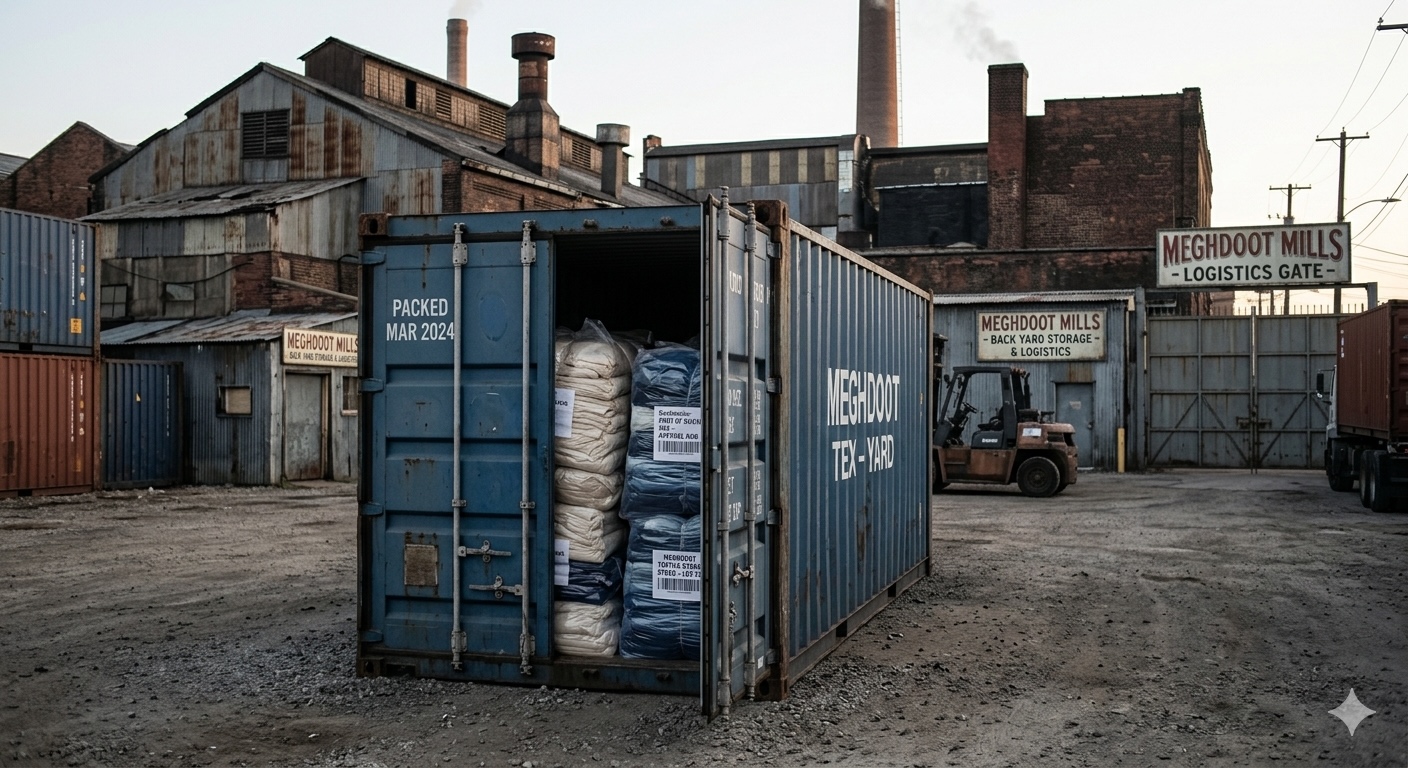
In a yard behind the mill the container that was packed in March still waits, and inside it the cloth is folded and bagged and addressed to a city none of these people will see, and one day soon the big gate will open and a lorry will take it down NH27 to a port, and a ship will take it across the water, and the number that the far government keeps setting and unsetting will decide whether it sells for a little more or a little less than it cost to make. It will sell. It always does, eventually. And somewhere a person will lift it off a rack, light weight and perfect, a shirt for the price of a sandwich, and will not feel in it the sixteen hours, or the half a claim, or the ten in every hundred, or the morning the small gate took a widow in. Because the whole engineering of the thing, the four hundred mills and the two and a half lakh hands and the highway that the people on it swear runs only one way, exists precisely so that the shirt should weigh nothing at all.
Written by Anupama Pain, based on visits in 2025 to the Bhilwara textile mill workers’ communities. The photographs are generated using Google Gemini AI models, to continue retaining the essence of the piece – a fiction. Albeit, the story borrows heavily from the observations, conversations and visuals during these meetings, that were possible due to the not-for-profit Shram Sarathi doing exemplary work in the region. You can find more about them here.


Will love to hear your thoughts on the topic here