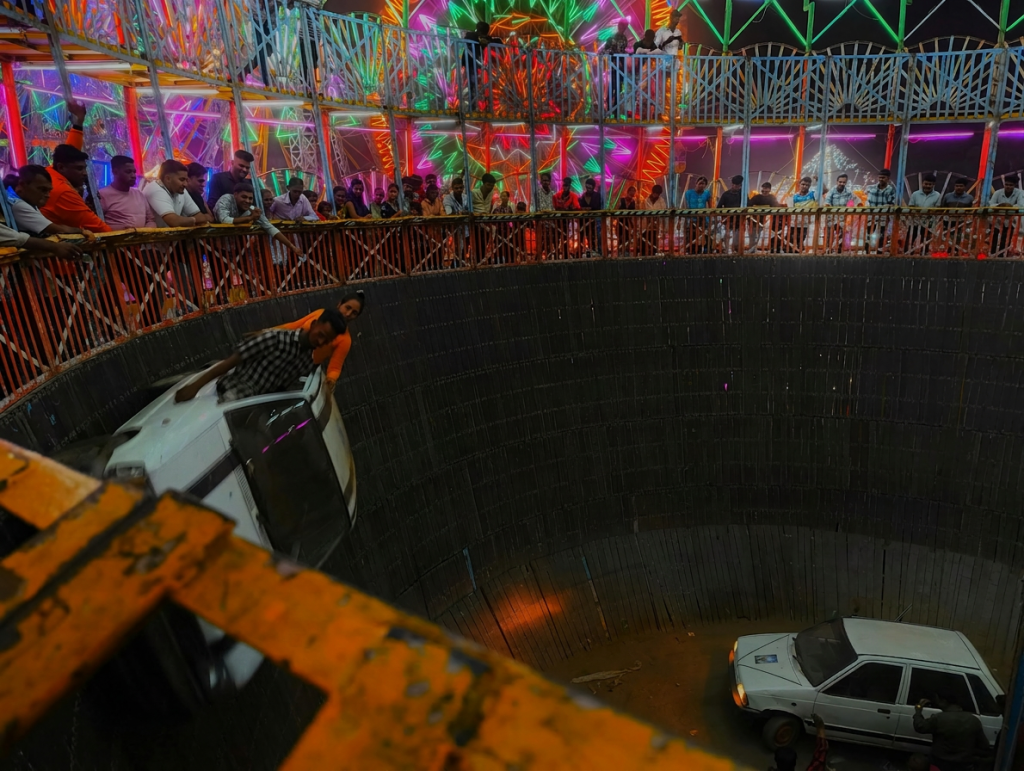
At most fairs in India, there is usually a Maut ka Kuwa. The Well of Death. A large circular wooden drum, perhaps twenty five feet feet deep, its vertical walls the track. Often men and infrequently women, ride motorcycles and cars into it, building speed along the flat bottom before climbing the walls by momentum, until they are horizontal to the ground, defying gravity for as long as the engine holds. Spectators lean over the top rim, aghast.
I have thought about Maut ka Kuwa often since visiting the sandstone quarries of Bijolia in Bhilwara district, Rajasthan. An open-cast mine is also a pit you look down into. The quarry walls are vertical and gyrated, men working at the base with tools and machines, doing things with their bodies that the body was not designed to sustain indefinitely. But the resemblance ends there. At a Maut ka Kuwa, everyone present understands the transaction: the danger is the spectacle, acknowledged by performer and audience alike, compensated by the hat passed around. In a sandstone quarry, there is no crowd. Nor hat. The danger is not the point. And for decades, the men at the bottom of these pits did not know what was happening to them.
Patthar ki Kheti (Stone Farming)
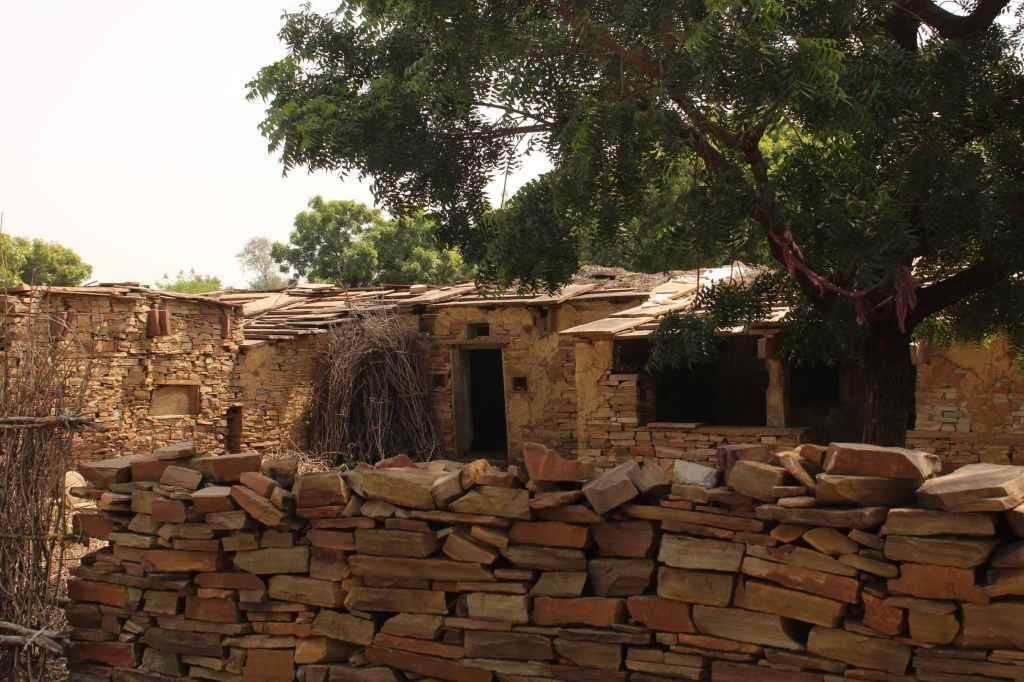
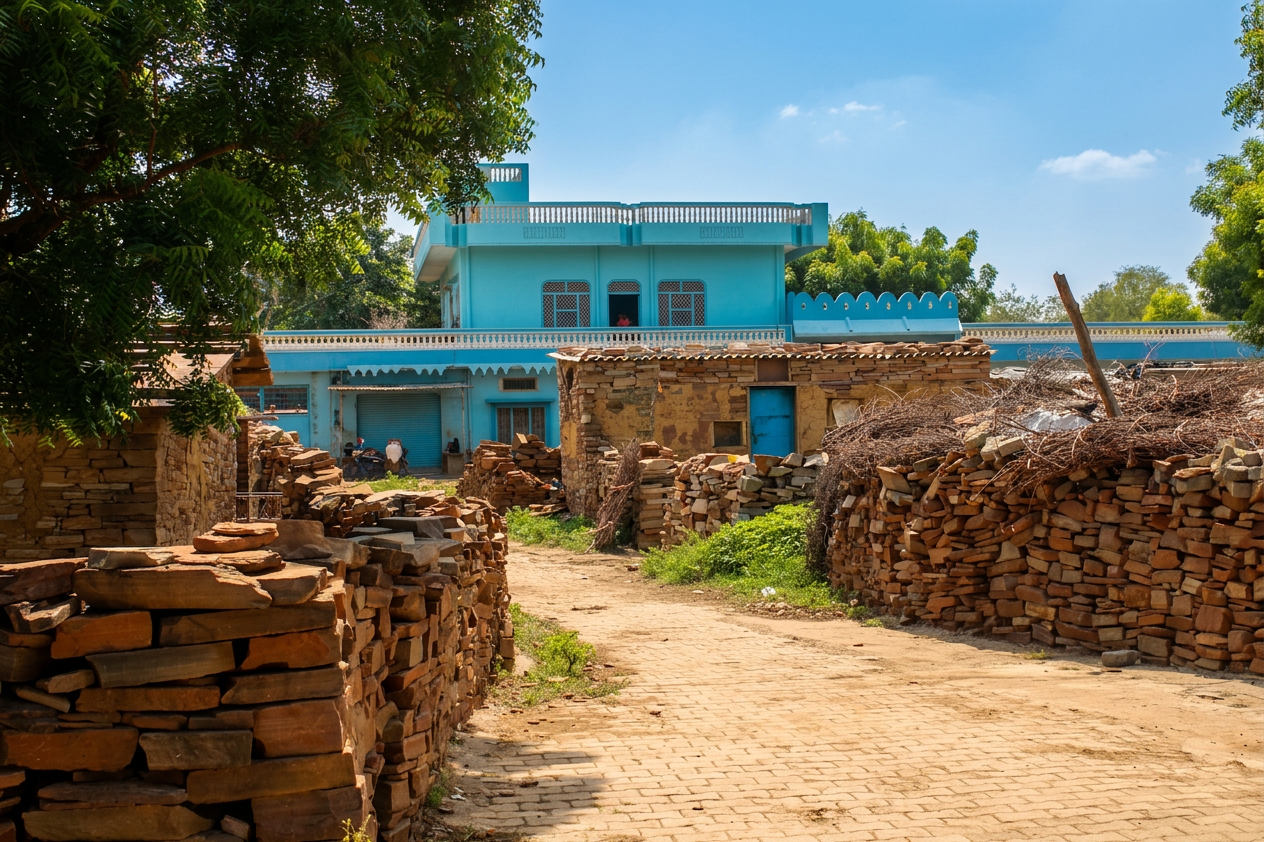
The first thing you notice, entering into Bijolia, is that the walls are unexpected. Almost plush. The boundary walls of village homes, the retaining walls along the highway, even the low dividers outside the panchayat office, all made of the same thick slabs of reddish-beige stone, stacked on each other with a carelessness, that looked like art.
The locals call this Patthar ki Kheti, the farming of stone. In the twenty one gram panchayats of Bijolia, eighteen have active sandstone mines in them. The stone is what this land grows.
Bijolia is also called Uparmal Pathaar (stone country). About 80% of India’s sandstone comes from this region. That amounts to roughly 10% of global sandstone production. I want to describe a mine, because the word mine does a lot of heavy lifting in this conversation between us. Mostly, we imagine something underground, enclosed, dark – the kind of thing that appears in disaster headlines or in movies like Gangs of Wasseypur and the KGF series.
The sandstone quarries of Bijolia are nothing like that.
They are open-cast, which means they are dug downward into the earth from the surface. As you approach, what you see first is a long flat clearing called the stock area, where stone slabs are sorted, given finishing cuts, and stacked for transport. Beyond it is the quarry itself. A deep rectangular pit, its walls striped in layers of reddish and ochre sandstone. Walls of loose soil and unwanted rock line the boundaries of each mine, often several metres tall. The debris of extraction piled up with this casualness, sometime overhanging in the backyard of a village home sitting dangerously close to the edge.
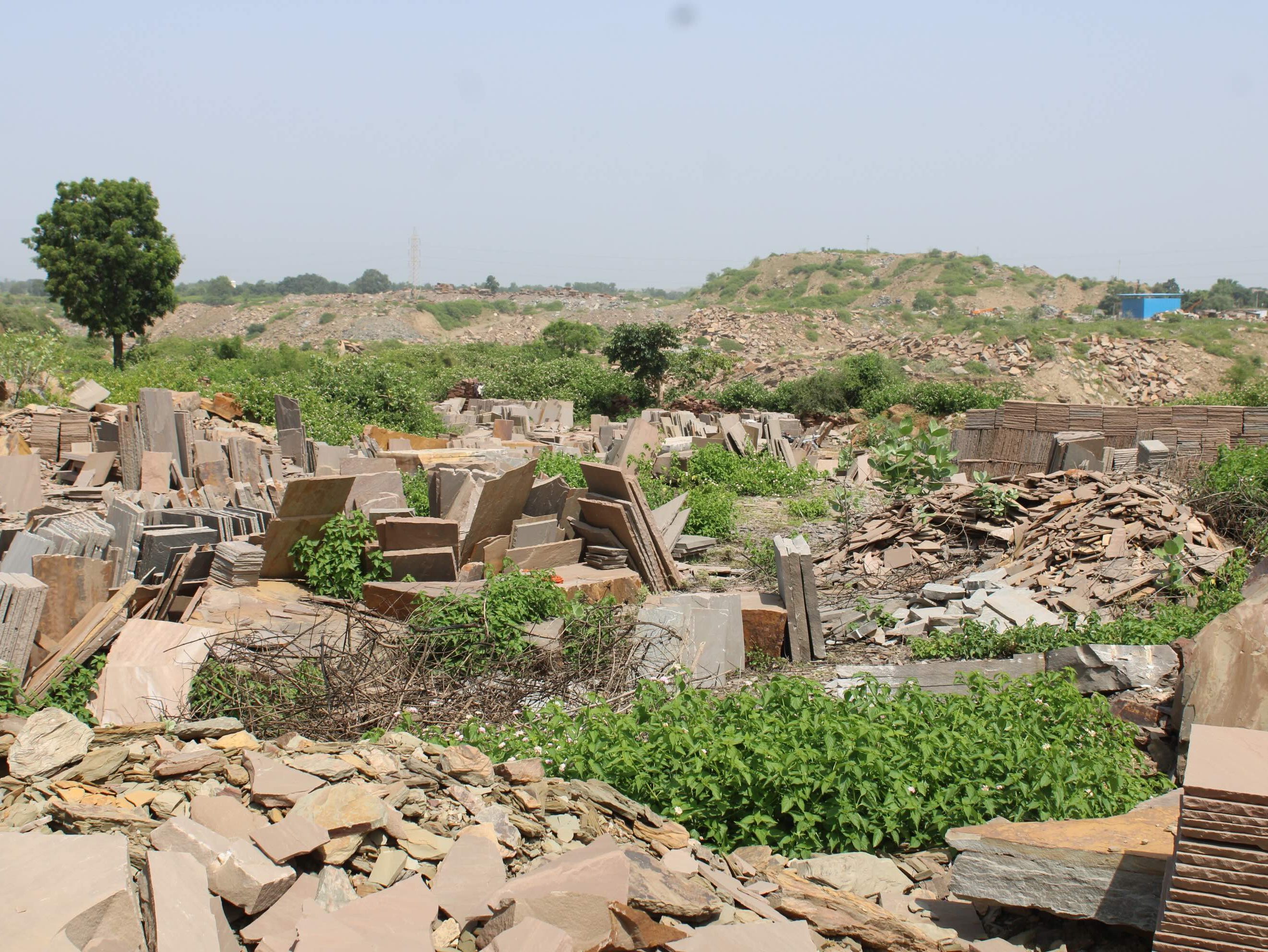
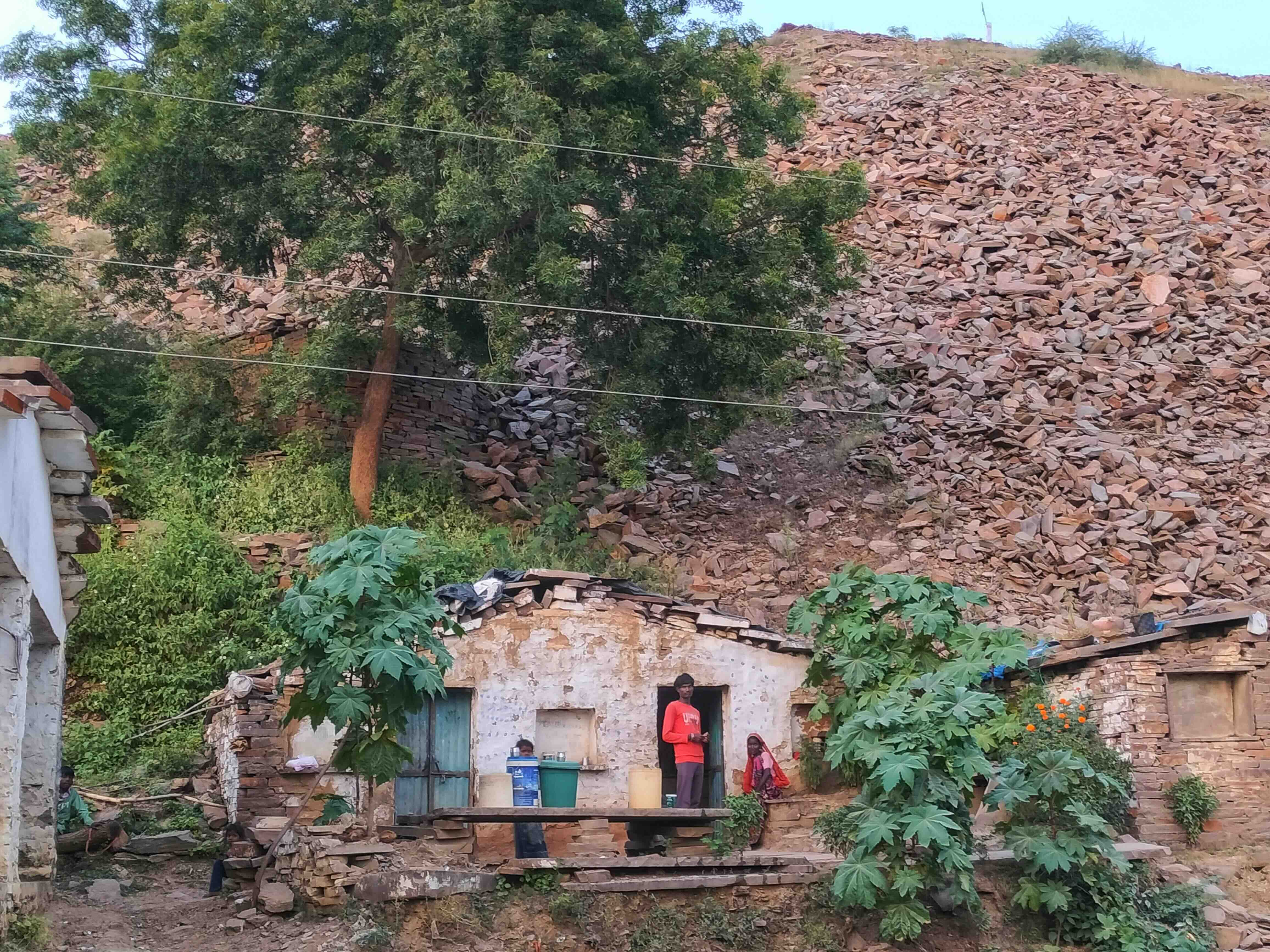
The debris also include fine silica dust, that does not stay on site alone. It settles everywhere – on rooftops, on the skin of vegetables in kitchen gardens, in the air that moves through the lanes of settlements built a generation before the mines expanded. Residents who have never set foot inside a quarry have spent decades breathing this thickened air. In November, when I made this visit, the mine pits are literally lakes. The water takes on the colour of the stone it is sitting against, that catches the light. This is perhaps the only point in this essay where we pause to engage with something beautiful.
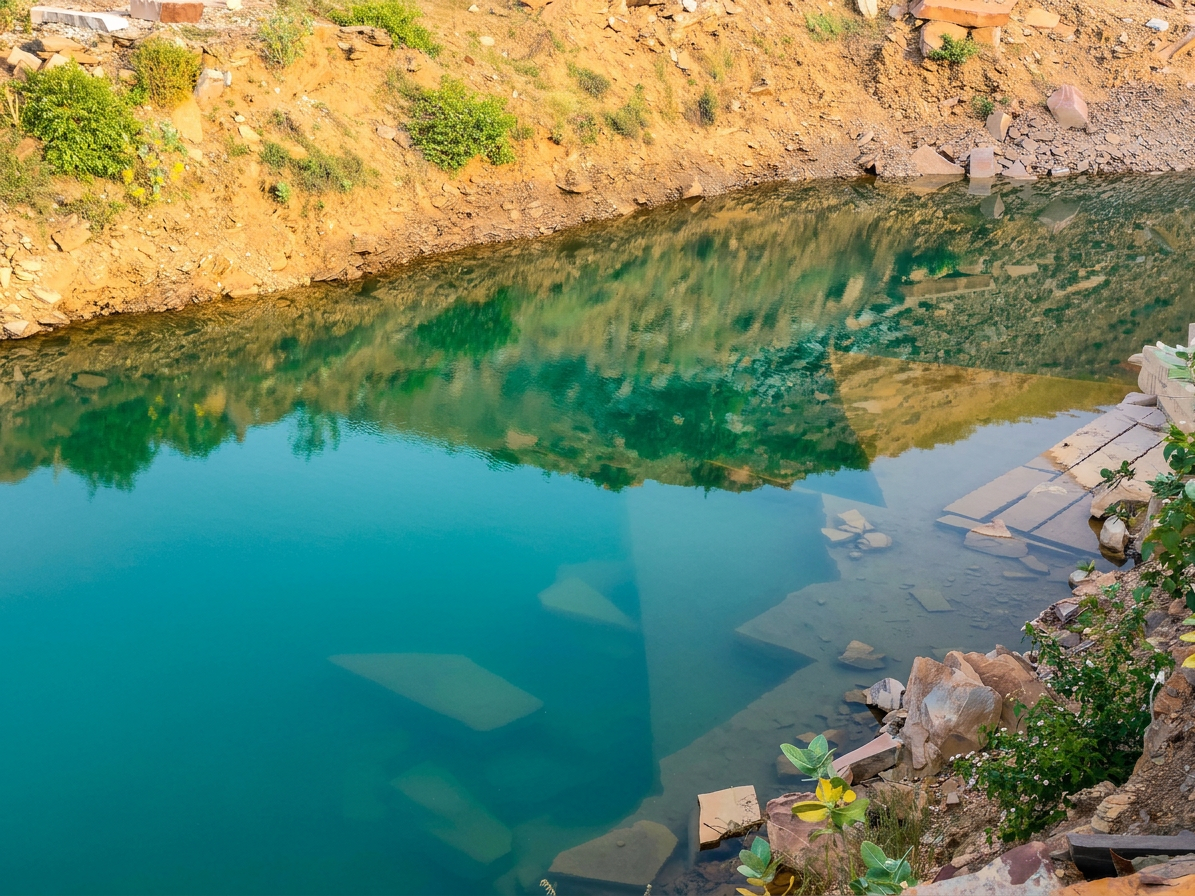
Work stops during monsoon. The quarry fills with water; pumping it out costs each mine ten to fifteen lakh rupees every year. I want you to remember this number; we will circle back to it.
From December to June, the quarries are active. There are roughly 1,560 registered mines in Bijolia. Each is estimated to employ around forty workers, between the quarry and stock. That gives you something close to 75,000 workers. Including locals and migrants from across Rajasthan, Uttar Pradesh, Bihar, and Madhya Pradesh. A 2018 study by the Centre for Sustainable Employment at Azim Premji University found that as many as 73% of the surveyed workers in the Bijolia mine area were from Dalit and Adivasi communities and belonged to ultra-poor families. About 5,000 of the 75,000 are women, mostly in support and clearance roles at the stocks. Almost no employment in the mines is formal. And so, take the figures above with a pinch of salt. Petty contractors act as intermediaries between groups of workers and the employer.
The Hierarchy of Dust
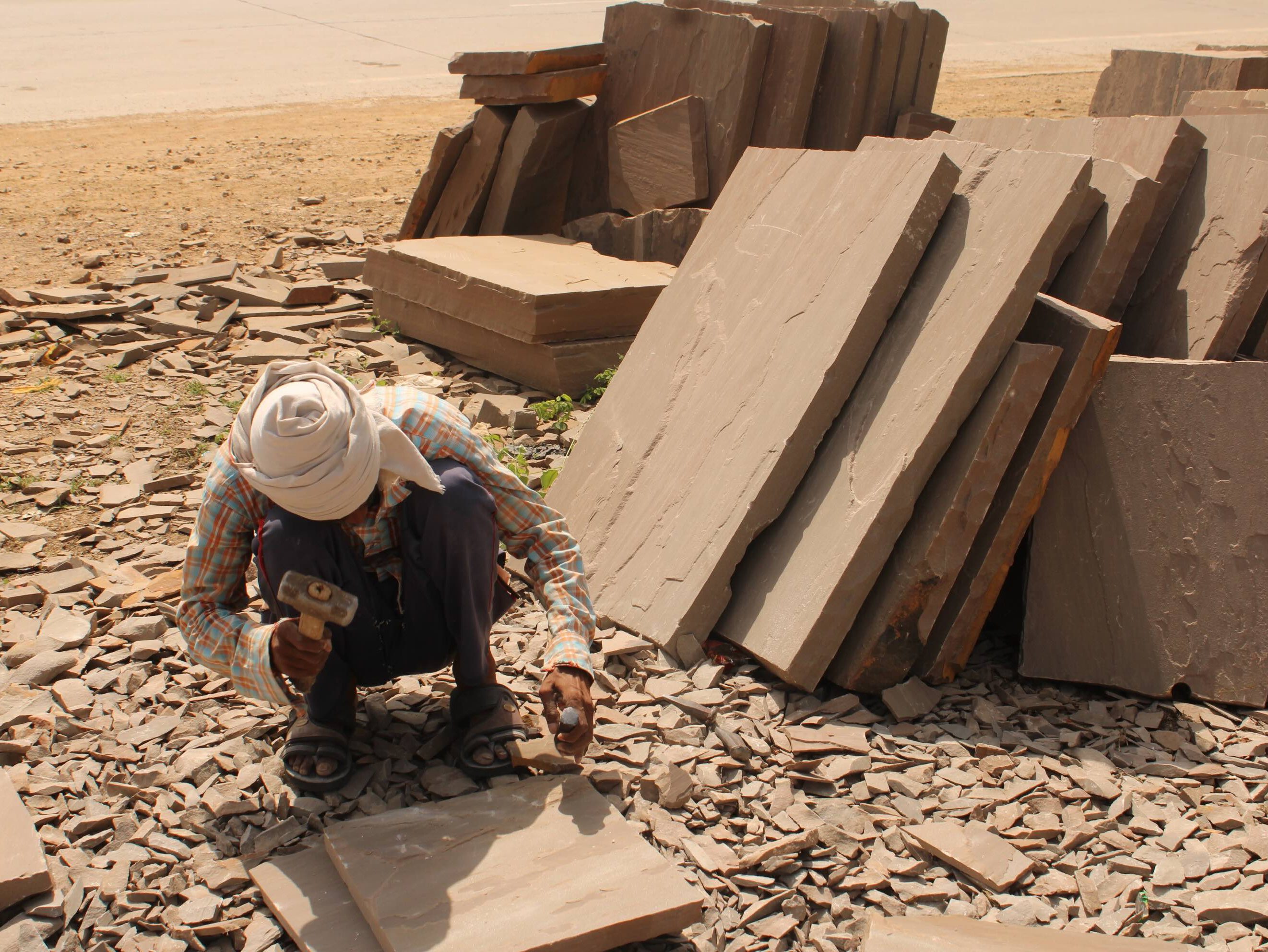
Not all workers in a mine breathe the same air. The extent of the damage, the way the same occupation can mean something entirely different depending on which end of a machine you are standing at. There are broadly three kinds of labour at the quarry. The first is chisel and hammer work; something similar to the worker seen in the above image. Often older men or those in the declining years of physical peak, use traditional tools to break the stone surface. The dust from this is significant, but there are rhythms to it, brief moments of relative stillness between strikes. The exposure is lower but chronic, spread across a working lifetime that begins as early as thirteen or fourteen. Studies suggest that complications from this kind of work show up after a decade or more of sustained exposure.
Then there are the drillers. The youngest men, the most able-bodied. They operate semi automatic drilling machines that bore into the stone, and as they do, a constant, visible cloud of fine silica dust rises around them. The worker stands inside this cloud, breathing through it, often invisible. For drillers, silicosis has been detected as early as two years into the work.
At the stocks, younger boys and older men, women, give finishing touches to the stone: chiselling, transporting, stacking. And then there are the hamaals (loaders) who move material between the quarry and the trucks, working in small groups at piece rates. Finally, there are JCB drivers. All of them are also exposed to silica dust, albeit at lower rates.
The fine silica dust settles everywhere – on rooftops, on the skin of vegetables in kitchen gardens, in the air that moves through the lanes of settlements built a generation before the mines expanded. Residents who have never set foot inside a quarry have spent decades breathing this thickened air.
The wages range from as low as two hundred rupees a day to two thousand for a skilled driller. That range is also, a map of risk. The more you earn, the more dust you breathe. If you are asking about protective gear, they exist. Technology to absorb the smoke is not rocket science. Often, as basic as wet sponges on chisel and hammer mouths have over 70% absorption. Drilling machines can be modified with an investment of ten thousand rupees to do the same. Here is where I will like you to recall the cost of draining out rain water, in comparison to this. Mine owners will spend where they see fit. And safety of the workers misses the mark by miles.
Patthar ki Bimaari (Disease of the Stone)
Silicosis is caused by the inhalation and deposition of silica dust in the lungs. The fine particles enters the lung tissue and causes fibrosis: a progressive, irreversible stiffening causing lungs to lose their elasticity. A person begins to find it harder to breathe; then impossible. There is no cure. It is frequently invisible in its early stages. The disease can develop or progress even after exposure has stopped. It is often misdiagnosed as pulmonary tuberculosis; so patients spend years and money on the wrong treatment. The tuberculosis medicines offer partial symptomatic relief, which deepens the confusion. Even after a correct diagnosis, there is nothing to do but slow its advance.
- The Rajasthan Workmen’s Compensation Rules of 1965 required employers to present new workers before medical boards for examination, and mandated follow-up checks every five years
- It took another three decades, 1993, for the state to constitute a Pneumoconiosis Medical Board (PMB). That board remained largely dysfunctional for another two decades
- It was in 2012 that the Rajasthan State Human Rights Commission began a serious compensation process
- In 2016, District Mineral Foundation Trusts (DMFT) were set up across the state to administer welfare funds from mining revenues
- 2025, the compensation structure currently stands at three lakh rupees upon detection, a monthly pension of fifteen hundred rupees, and an additional two lakh after death to closest kin
Rajasthan has done more than most Indian states on this, by the way. An online portal for silicosis registration was introduced to reduce the corruption of middlemen who had been taking cuts from compensation seekers for navigating the bureaucracy. PMBs have been expanded to the sub-district level. However, the money that a patient receives sounds significant in the abstract. In practice, it rarely arrives ahead of the debt. A worker who has spent years being treated for tuberculosis has borrowed heavily along the way. By the time the silicosis is correctly named and the compensation processed, there is not much choice on the usage of the money. One worker I heard about had received his compensation eventually, after being returned with negative results twice despite apparent symptoms. He showed his certificate with a kind of exhausted relief.
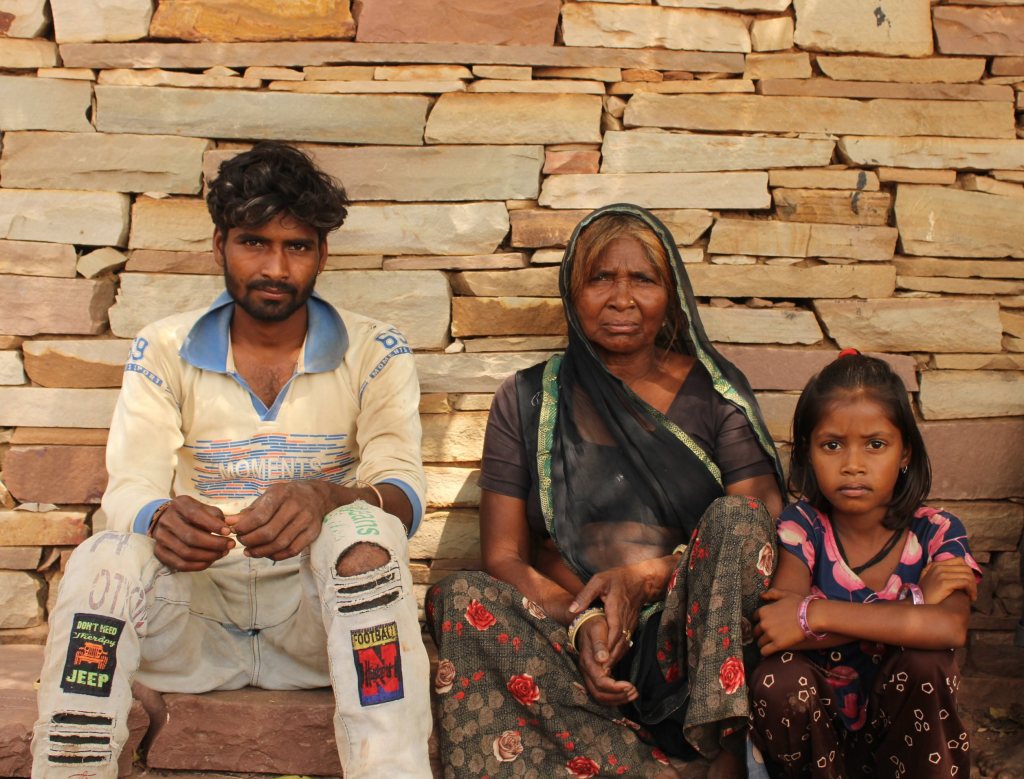
Even among those who have managed to redirect compensation into something new; a small shop, a few goats, a sewing machine – the transformation is precarious. The policy does not deliver an exit from the economy that produced the illness. We met a woman, the matriarch of a family that has been losing its men to the mines for as long as she could remember. She was sitting outside her home with her grandson, and her great-granddaughter.
The grandson was twenty-five. A driller. He had been recently detected with silicosis.
Her husband, her son, had also gone the same way. This grandson had started working in the mines at thirteen, she said. The family needed income; the mines paid more than anything else available. There is a cruelty in the economics of a silicosis household. Once a worker is too ill to continue, younger family members begin working to compensate for the lost income. They often go to the same mines.
The situation compounds further when awareness, creates a boomerang effect the system was not built to absorb. More camps, more detection, more claims. But before rejoicing, an alarm is already being raised by civil society organisations working towards it. The funding from DMFT is not elastic, the PMBs have limited capacity, and the response has been to return workers with evident symptoms as negative cases. To acknowledge, the administrators also find themselves in a catch twenty-two. It is clinically not possible to confirm silicosis with 100% surety. There is always room for it being a false negative, or positive.
Screening camps are organised at the gram panchayat level. A migrant is not attached to the gram panchayat. As local workers in Bijolia, increasingly aware of the risk, have begun refusing the most dangerous tasks, particularly drilling, contractors have responded by sourcing workers from further away, men with less information and more distress. When their body refuses to work, they return to their source villages carrying the illness in their lungs, outside the reach of any compensation mechanism, invisible to the state that notified the disease. The illness is no longer only a story of Bijolia. Karauli, Jhabua, Samastipur … it is travelling in every direction.
The Blue House View
When I walked into one of the settlements near the mines in Bijolia, the first thing visible was a large blue house. It belonged to a local quarry owner. Directly opposite it a woman in her fifties sat in a plastic chair outside her modest hut, and on a charpai (rope cot) beside her lay her son. He was in the final stages of silicosis. He did not get up during the time we were there. His mother told she had already lost her husband, also a miner worker, some years earlier. She could not confirm what he died of. Before 2015, there was no real awareness of silicosis.
“He went the same way,” she said.
Both father and son worked in the mine of the blue house owner. She was not angry, exactly. Or she was, but in the way that someone who has been angry for a very long time carries it. Funnily, the only thought that came to my mind, was if the cot could be shifted, so that he does not have to de-facto open his eyes and see the blue house. I was not sure he was in a physical state to turn his face away from it on his own. To compensate for what I felt as lack of adequate anger in them, I was already feeling enough angry as the conversation progressed.
Why was no one upset enough? Did the poetic injustice of it all, missed the others?
The Lucky Ones
Then there were two older men who had worked in the mines for over thirty years. Both were alive and working, sitting near the stock in the late afternoon, taking a break. They were, by the account of everyone around them, remarkable. “Bade naseeb wale“, of exceptionally good fortune to have worked that long and still be here, still breathing. They did not particularly consider themselves lucky. What they spoke of, when they talked, was that they had been missed. There were cut-off dates for check ups they had not found out timely, certifications they had not known to seek. They had heard about it through others. They had seen neighbours and younger men receive their compensation. They had watched, from their post of fortunate survival.
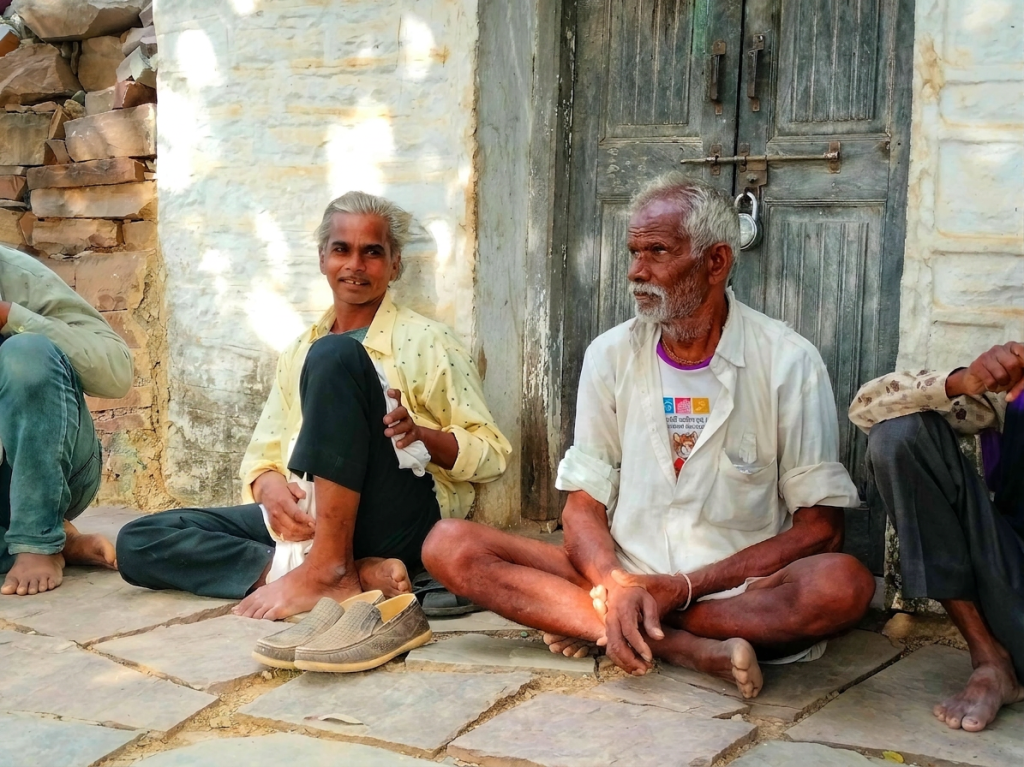
“Sabki bimaari ek jaisi nahi dikhti. Kabhi kabhi andar hota hai, par aadmi ko pata nahi chalta” (The illness does not look the same on everyone. Sometimes it is there inside of you, but you do not realise it)
They still went to work everyday. The remark took me to a summer in Yavatmal, Vidarbha region of Maharashtra. Fifteen years ago, in 2010. Where compensation for suicide due to agrarian distress went into buying a high end motorcycle or a Maruti Alto car. Amongst us who were doing field surveys, it was almost a proxy indicator that if there was no motorcycle or car in the front yard, the farmer inside the house was perhaps still alive …
Where Does the Stone and Anger Go
“Our stones go as far as Europe and America. It is of such good quality that the rich in those countries use it for decorating their homes – outer walls, statues, fittings in toilets, kitchens and gardens.”
The contractor volunteered this information. He was proud of it. He meant it as a measure of the quality. Sandstone from Uparmal Pathaar leaves in trucks, reaches railheads, travels to processing yards, and from there makes its way to construction sites and showrooms. It becomes flooring in hotels and courtyard paving in civic spaces and the outer cladding of expensive residential buildings. It is used in decorative walls in the kinds of homes where people press their palm against stone and feel a warmth they might describe as rustic, or simply beautiful.
As we sat for a debrief with some mine worker union’s leaders, one of them asked,
“Aap kahaan se hai?” (Where are you from?)
“Delhi”
“Tab to aapke bhi phephde humare se alag nahi. News mein suna hai pradushan ke baare mein” (Then your lungs are not very different from ours. The news covered the pollution issue there)
I lived in Delhi when AQIs hit 999+. And eventually when I did leave, it was out of other reasons. The air quality was not a part of that decision. I am wondering if someone is feeling the share of the anger on behalf of the people of Delhi. Where does our anger go when it leaves us?
Further Reads and References
- Bijolia’s Harvest of Stone: Conditions of Work Among Quarrying Labour in Rajasthan — Anumeha Yadav, Centre for Sustainable Employment, Azim Premji University, May 2018
- Rajasthan Policy on Pneumoconiosis – Silicosis Detection, Prevention, Control and Rehabilitation — Government of Rajasthan, September 2019
- Silicosis – An Ancient Disease: Providing Succour to Silicosis Victims, Lessons from Rajasthan Model — Prahlad K. Sishodiya, National Institute of Miner’s Heath, April 2022
These observations and conversations were possible due to the community visits organised by Grameen Avam Samajik Vikas Sanstha (GSVS) doing exemplary work on the issues highlighted. You can find more about them here.
Written by Anupama Pain, based on visits between 2022 and 2024 to the Bijolia mining community. The photographs are clicked by the author with appropriate consent.
Cover photo courtesy Rishikesh Dharane.


Will love to hear your thoughts on the topic here