In early 2024, The Enforcement Directorate (ED) has unearthed a hawala nexus that used money earned from smuggling of human hair from India to China and other countries. The news gained a lot of traction. This took me back to an interaction I had in the hinterland of Gujarat.
I was working with a not for profit organisation, providing legal aid for the deserving but poor clients. I was visiting one of our centres in Umarpada block of Surat district. This dainty quite block is predominantly a tribal area, some of these villages were displaced during the construction of the Tapi dam, some are the beneficiaries of Forest Rights Act (FRA), 2006 and all for a fact are closely connected with their Jan-Jal-Jungal-Jameen-Janwar (people, water, forest, land, animal).
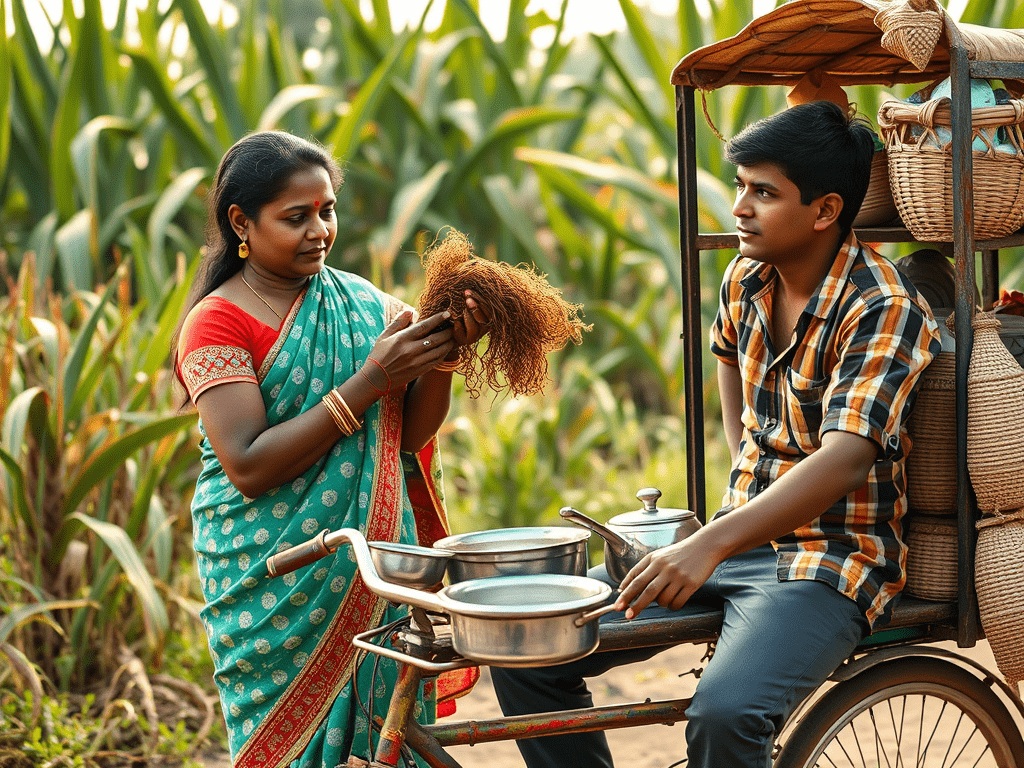
This event I recount is from a day in the Ghanawar village of Umarpada. Ghanawar has two communities – Adimjati (translates to primitive or original tribe) called Kotwalia, the indigenous tribe of bamboo basket makers and labourers in the sugarcane farms of neighbouring owner-cultivators. I met a man hailing from Uttar Pradesh. He was there for business, sitting on a bike van with a cool-boy attitude. He had modified the carrier to be a kind of a mobile shop at first glance. The largest portion of the carrier was filled with kitchen utensils and daily utilities.
This event I recount is from a day in the Ghanawar village of Umarpada. Ghanawar has two communities – Adimjati called Kotwalia, the indigenous tribe of bamboo basket makers and labourers in the sugarcane farms of neighbouring owner-cultivators.
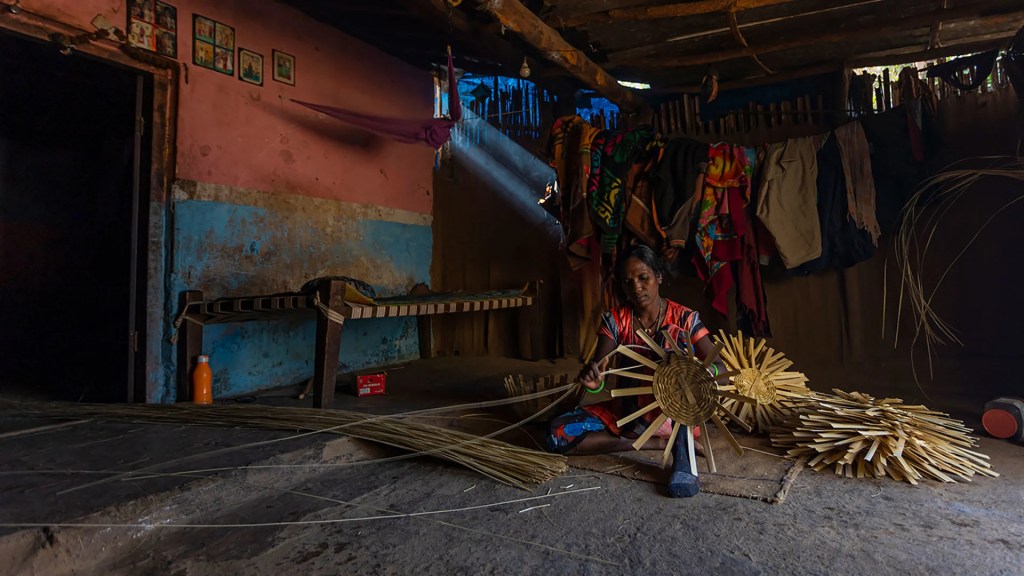
A Kotwalia tribal woman weaving a bamboo basket; courtesy roundglasssustain.com
How many rounds he does around here? Is his effort worth the money he could earn from a village which does not seem to have adequate purchasing power? He clarifies, he was there to sell utensils in return of hair. A middle aged women, walks past me with handful of curly hair and the man instantly puts the hair in his white sack and gives her a small steel bowl.
How do you know the cost of that hair ball without weighing it?
I am in this business for the past eleven years, that much hair is worth Rs.25; I can say it from experience. I earn around Rs.1000-Rs.2000 in a day, it is a good business. I am earning well.
What happens to all this hair?
“Humko kya karna hai usse. Kolkata jaata hai baal.” (“Why would I care about that? Most of this gets transported to Kolkata.”)
I remember having mixed feelings about this incident. All the villagers seemed comfortable with the practice. Fair skin and long black hair, among other things have been prominent markers of feminine beauty in many communities in India. One would assume, chopping off long hair would receive complex reciprocation from the people. However, there seemed no taboo around the barter, except the fact that majority of married women wore a long cloth on their heads, covering the reality of their tethered head scape.
With modern price-based, cash-driven marketplace reaching all corners of the country today, the remains of the traditional barter, have morphed in form. While human labour barter forms are still rampant, especially in case of farming, other forms of exchanges without a price intermediary are on the decline. Even if they do, they are in very closed-loop direct exchanges, between kins or neighbours. Some variations like Kerala’s toddy shop economy have barely survived. In niche communities which aspire to have a sustainable lifestyle, barter is making a fashionable come back.
Albeit, to find it at the first level of exchange between the producer and middleman in a rather complex and long supply chain that pans countries is interesting. The immediate urge is to do the math and arrive at the tangible and intangible costs of this to the producer and if the compensation is commensurable.
The human hair trade has been a thick area of interest amongst global cultural anthropologists for a long time now, India being at the epicentre of it. Also, how an economic benefit had managed to transcend beauty benchmarks and sentiments in our culture around them. An Economic Times article states,
“India dominates the global wig market, supplying 88% of human hair exports, valued at $138 million. This thriving industry, fueled by temple donations and recycled comb hair, supports over 61 million people and generates over $500 million annually.”
The practice was apparently a well-known fact for my other colleagues at Umarpada. Later in the evening, I visited the house of one of my colleagues, and to my wonder, even his wife wore a long head scarf. But, then who am I to judge the fairness of barter? Who am I to click pictures of these women with long scarves? Nobody takes my picture when I ask for chocolates in return for a friendly favour.
Further Reads & References
- On hawala nexus in human hair smuggling in The Tribune India, 5th March 2024
- On human hair export chain originating from India in South China Morning Post, 2nd July 2023
- On the Black Gold hustle: India’s wig market in The Economic Times, 24th November 2024
- Story: Yatti Soni who worked for a year in 2016-17 in Gujarat in western India
- Editor: Anupama Pain, Chabutra Team


Will love to hear your thoughts on the topic here